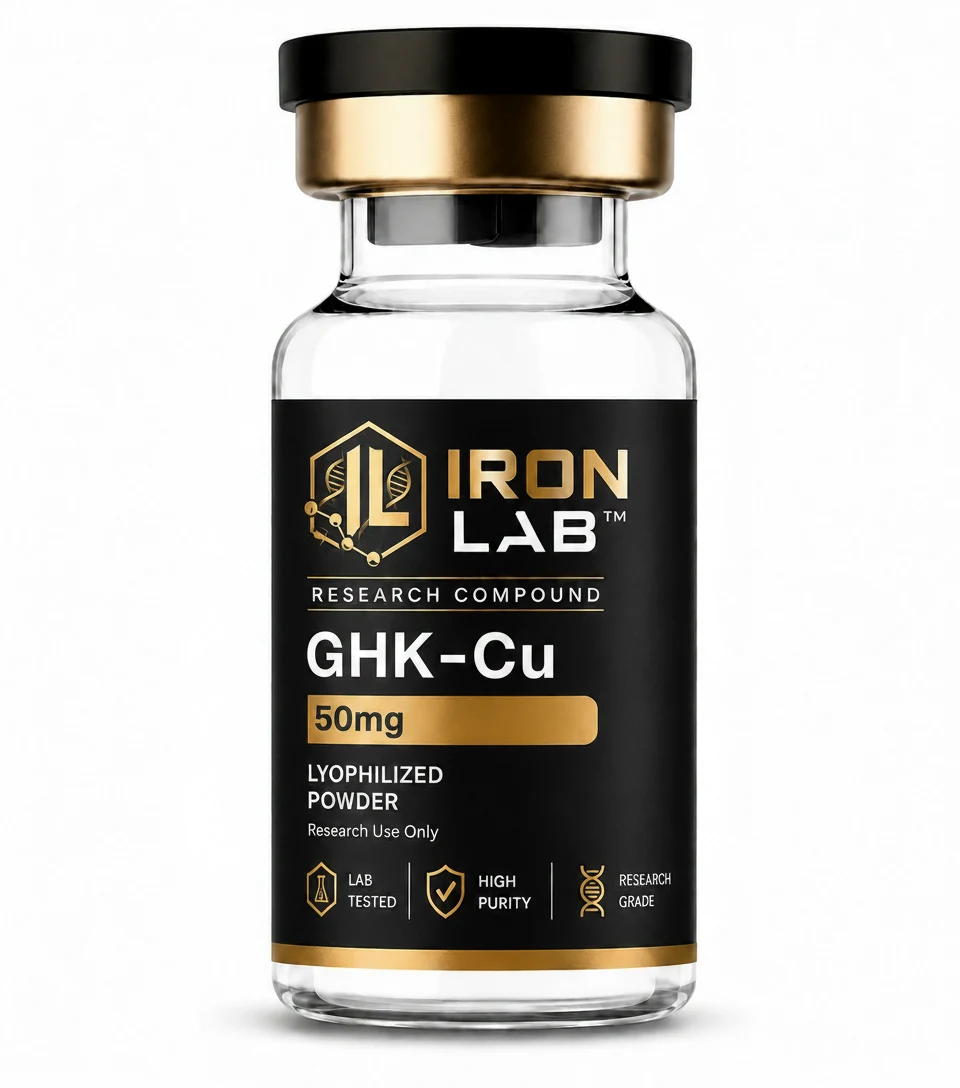
GHK-Cu — also known as the copper peptide or GHK copper peptide — research profile covering complex chemistry, signaling, and laboratory verification.
Inside an Australian research workflow, ghk cu is judged less on hype and more on three boring metrics: HPLC purity, mass-spec identity match, and post-reconstitution stability at 2–8 °C. Everything in this article is organised around those three checkpoints.
GHK-Cu is the copper-bound complex of the tripeptide glycyl-l-histidyl-l-lysine (GHK). First isolated from human plasma, the complex is one of the most extensively documented bioactive peptides in US dermatological and tissue-research literature.
Complex chemistry
The GHK sequence coordinates a divalent copper ion (Cu²⁺) through the imidazole nitrogen of histidine, the α-amino group of glycine, and the deprotonated peptide nitrogen. The resulting square-planar complex is the signaling-active species and produces the characteristic deep-blue color used during qualitative batch verification.
Documented research signaling
- Modulates expression of genes related to extracellular matrix turnover in cultured fibroblasts.
- Influences SOD and antioxidant enzyme expression in published in-vitro models.
- Demonstrates affinity for collagen and decorin binding sites in laboratory studies.
- Reported to support angiogenic markers in cell-culture wound-model literature.
What a verified GHK-Cu COA includes
- ≥98% HPLC purity of the GHK peptide
- Quantified copper content (~17–20% by mass for the 1:1 complex)
- LC-MS confirmation of GHK mass (340.4 Da)
- UV-Vis absorbance at ~620 nm consistent with the Cu²⁺ complex
Frequently asked research questions
Is GHK-Cu the same as the copper peptide?
Yes. "Copper peptide" and "GHK copper peptide" both refer to the GHK-Cu complex.
What does the blue color mean?
The deep blue color is the absorbance signature of Cu²⁺ coordinated by GHK and is a qualitative indicator the complex has formed correctly.
Why Ghk cu matters to research labs
Australian research teams evaluating ghk cu face three recurring questions before any in-vitro work begins: is the compound what the label claims, will it remain stable across the planned experimental window, and does the supplier's documentation hold up to the standards a principal investigator will sign off on. The remainder of this article is structured around those three questions.
Iron Labs supplies ghk cu as a lyophilised research material packaged for transit at ambient temperatures and long-term storage at −20 °C. Every batch ships with a lot-specific certificate of analysis covering identity, purity, residual solvents and endotoxin where downstream cell culture work is anticipated.
Typical research applications
Across the published literature, ghk cu appears most often in three workflow categories. Each has its own documentation profile and storage requirements, which is why a single supplier batch is frequently subdivided across multiple aliquots to limit freeze-thaw cycling.
- In-vitro receptor binding and signalling characterisation, where milligram-scale aliquots are reconstituted fresh on the day of assay.
- Pharmacokinetic and stability modelling, where reconstituted material is sampled at defined time-points and analysed by RP-HPLC.
- Comparative reference work, where ghk cu is benchmarked against in-house standards or other published research compounds.
Reconstitution and handling reference
Lyophilised ghk cu is reconstituted with sterile bacteriostatic water using slow, side-of-vial addition to avoid foaming. The vial is allowed to dissolve passively rather than being shaken; mechanical agitation accelerates aggregation in many peptide systems and complicates downstream analytical work. The table below summarises common reconstitution volumes used as documentation references.
| Vial Strength | Diluent Volume | Resulting Concentration |
|---|---|---|
| 5 mg | 1.0 mL bacteriostatic water | 5 mg/mL |
| 10 mg | 1.0 mL bacteriostatic water | 10 mg/mL |
| 10 mg | 2.0 mL bacteriostatic water | 5 mg/mL |
| 30 mg | 3.0 mL bacteriostatic water | 10 mg/mL |
Storage and stability envelope
Lyophilised ghk cu is documented as stable for 24+ months at −20 °C protected from light. Once reconstituted, the published storage reference for most research peptides in this class is up to 30 days at 2–8 °C when handled aseptically; longer-term storage of reconstituted material is best achieved by single-use aliquoting at −80 °C to remove freeze-thaw variables from later analytical reads.
- Avoid storing reconstituted vials in the refrigerator door — temperature swings shorten usable life.
- Label aliquots with batch ID, reconstitution date and concentration so retrospective audit is straightforward.
- Do not refreeze previously thawed aliquots; integrate single-use volumes into the assay design from the outset.
Quality benchmarks Iron Labs publishes
| Parameter | Iron Labs Spec | Method |
|---|---|---|
| HPLC purity | ≥ 98% | RP-HPLC, UV 214 nm |
| Identity | ± 0.5 Da of theoretical mass | LC-MS or MALDI-TOF |
| Endotoxin | Reported per lot | LAL kinetic chromogenic |
| Counterion | Quantified | Ion chromatography |
| Water content | < 8% (typical lyophilised) | Karl Fischer |
Further reading
Continue with the related Iron Labs research references linked at the foot of this article, or browse the full research catalogue for the compound class profile, lab-results archive and laboratory documentation. For sourcing questions, the research team is available via the Iron Labs contact page.