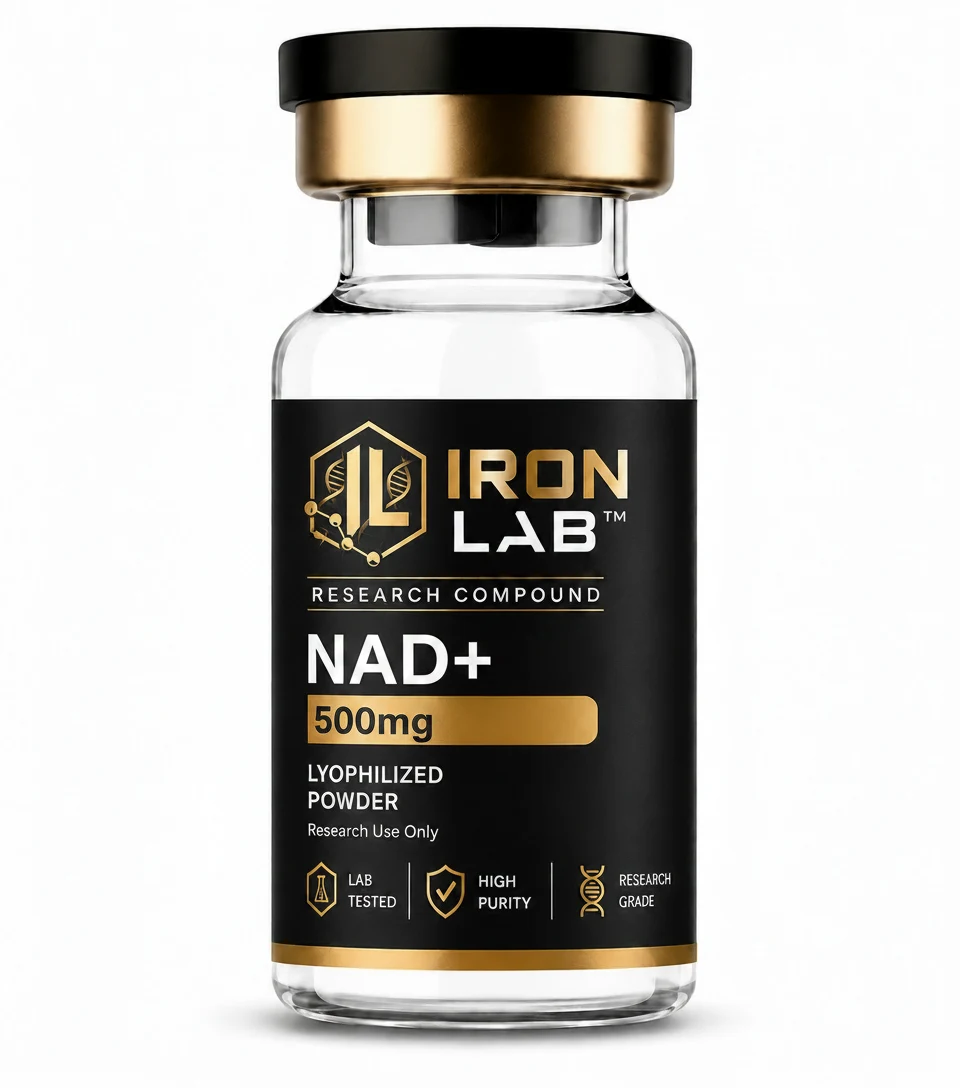
Nicotinamide adenine dinucleotide (NAD+) — central redox cofactor — research reference for laboratory work.
NAD+ (nicotinamide adenine dinucleotide) is the central redox cofactor for hundreds of catabolic enzymes and the substrate for sirtuin and PARP signalling. As a research compound, it is one of the most heavily characterised molecules in cellular metabolism literature.
- Molecular weight 663.43 Da
- Highly water-soluble
- Light- and temperature-sensitive in solution
Why Nad plus matters to research labs
Australian research teams evaluating nad plus face three recurring questions before any in-vitro work begins: is the compound what the label claims, will it remain stable across the planned experimental window, and does the supplier's documentation hold up to the standards a principal investigator will sign off on. The remainder of this article is structured around those three questions.
Iron Labs supplies nad plus as a lyophilised research material packaged for transit at ambient temperatures and long-term storage at −20 °C. Every batch ships with a lot-specific certificate of analysis covering identity, purity, residual solvents and endotoxin where downstream cell culture work is anticipated.
Typical research applications
Across the published literature, nad plus appears most often in three workflow categories. Each has its own documentation profile and storage requirements, which is why a single supplier batch is frequently subdivided across multiple aliquots to limit freeze-thaw cycling.
- In-vitro receptor binding and signalling characterisation, where milligram-scale aliquots are reconstituted fresh on the day of assay.
- Pharmacokinetic and stability modelling, where reconstituted material is sampled at defined time-points and analysed by RP-HPLC.
- Comparative reference work, where nad plus is benchmarked against in-house standards or other published research compounds.
Reconstitution and handling reference
Lyophilised nad plus is reconstituted with sterile bacteriostatic water using slow, side-of-vial addition to avoid foaming. The vial is allowed to dissolve passively rather than being shaken; mechanical agitation accelerates aggregation in many peptide systems and complicates downstream analytical work. The table below summarises common reconstitution volumes used as documentation references.
| Vial Strength | Diluent Volume | Resulting Concentration |
|---|---|---|
| 5 mg | 1.0 mL bacteriostatic water | 5 mg/mL |
| 10 mg | 1.0 mL bacteriostatic water | 10 mg/mL |
| 10 mg | 2.0 mL bacteriostatic water | 5 mg/mL |
| 30 mg | 3.0 mL bacteriostatic water | 10 mg/mL |
Storage and stability envelope
Lyophilised nad plus is documented as stable for 24+ months at −20 °C protected from light. Once reconstituted, the published storage reference for most research peptides in this class is up to 30 days at 2–8 °C when handled aseptically; longer-term storage of reconstituted material is best achieved by single-use aliquoting at −80 °C to remove freeze-thaw variables from later analytical reads.
- Avoid storing reconstituted vials in the refrigerator door — temperature swings shorten usable life.
- Label aliquots with batch ID, reconstitution date and concentration so retrospective audit is straightforward.
- Do not refreeze previously thawed aliquots; integrate single-use volumes into the assay design from the outset.
Certificate of analysis — what to verify
Every Iron Labs nad plus lot is dispatched with a certificate of analysis (COA) tied to the batch identifier printed on the vial. Reviewing the COA before the material enters the workflow is the single highest-leverage quality control step a research lab can perform.
- Batch / lot identifier and synthesis date — both must match the vial.
- RP-HPLC purity, typically ≥98% for research-grade nad plus.
- Mass-spectrometry identity confirmation (LC-MS or MALDI-TOF) within ±0.5 Da of the theoretical mass.
- Counterion identity and percent (acetate or trifluoroacetate are the most common).
- Bacterial endotoxin per the published analytical method, reported in EU/mg.
- Residual solvents and water content where the synthesis route makes them analytically meaningful.
Quality benchmarks Iron Labs publishes
| Parameter | Iron Labs Spec | Method |
|---|---|---|
| HPLC purity | ≥ 98% | RP-HPLC, UV 214 nm |
| Identity | ± 0.5 Da of theoretical mass | LC-MS or MALDI-TOF |
| Endotoxin | Reported per lot | LAL kinetic chromogenic |
| Counterion | Quantified | Ion chromatography |
| Water content | < 8% (typical lyophilised) | Karl Fischer |
Frequently asked research questions
Is the nad plus supplied by Iron Labs intended for human use?
No. All Iron Labs material is supplied strictly for in vitro and laboratory research use. Nothing on this page constitutes medical, veterinary or therapeutic advice.
How is nad plus shipped and how long is the transit-stable window?
Material is dispatched as a lyophilised powder, sealed and protected from light. Transit at ambient temperatures over typical Australian courier timelines is well within the published stability envelope for this compound class.
Will a Certificate of Analysis be provided with my nad plus order?
Yes. Every batch ships with a lot-specific COA covering identity, purity and the analytical parameters listed in the quality benchmarks section above.
Can I request a specific batch or repeat lot of nad plus?
Repeat-lot requests are supported for ongoing research programs; contact the Iron Labs research desk with the previous COA reference and the team will hold inventory from a matching batch where available.
Further reading
Continue with the related Iron Labs research references linked at the foot of this article, or browse the full research catalogue for the compound class profile, lab-results archive and laboratory documentation. For sourcing questions, the research team is available via the Iron Labs contact page.