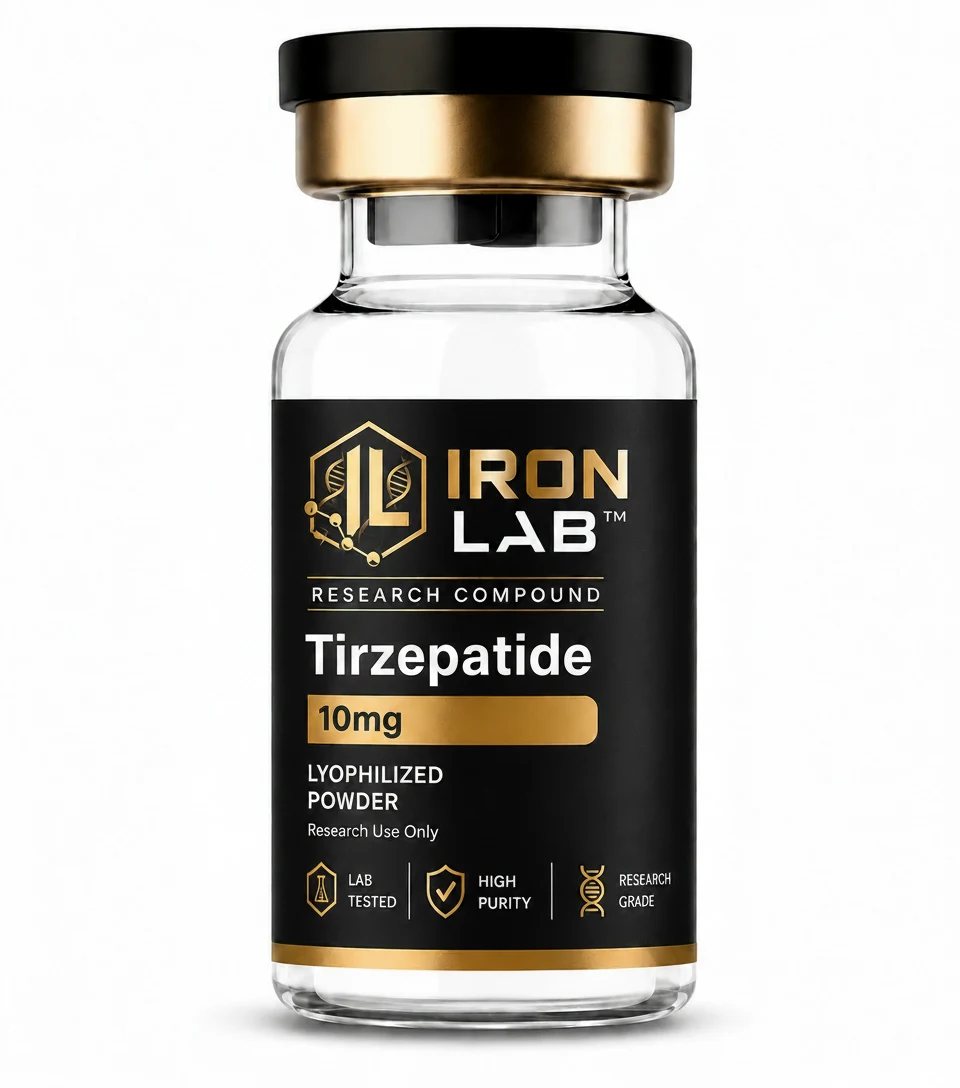
A complete Australia research reference for tirzepatide — dual GIP/GLP-1 receptor agonism, published study data, and analytical documentation expectations.
Inside an Australian research workflow, tirzepatide is judged less on hype and more on three boring metrics: HPLC purity, mass-spec identity match, and post-reconstitution stability at 2–8 °C. Everything in this article is organised around those three checkpoints.
Tirzepatide is a once-weekly synthetic peptide that engages both the GIP and GLP-1 incretin receptors. In the Australia research landscape, it has become one of the most heavily characterized incretin agonists, with extensive published pharmacokinetic, glycemic, and weight-related data sets used as reference material in laboratory study design.
This guide consolidates the documentation an Australian research laboratory typically reviews when sourcing tirzepatide for research: structural identity, batch documentation, dosage references published in literature, stability and reconstitution behavior, and the analytical methods used to verify each lot.
What is tirzepatide?
Tirzepatide is a 39-amino-acid linear peptide engineered from the native GIP backbone with substitutions that confer dual receptor agonism and resistance to DPP-4 cleavage. A C20 fatty diacid moiety extends plasma half-life via reversible albumin binding, supporting the once-weekly research administration interval seen in published study protocols.
Mechanism of action
- Dual agonism at the GIP and GLP-1 receptors — both class B GPCRs.
- Sustained albumin binding extends circulating half-life to roughly 5 days in published human pharmacokinetic studies.
- DPP-4-resistant backbone modification preserves bioactive structure across the dosing interval.
- Downstream cAMP signaling supports the glucose- and weight-related endpoints reported in SURPASS and SURMOUNT publications.
Tirzepatide research dosage reference
Published clinical research literature most commonly references the following weekly tirzepatide titration schedule. This is provided strictly as a literature reference, not as guidance for use.
| Week | Reference Weekly Dose | Phase |
|---|---|---|
| 1–4 | 2.5 mg | Initiation |
| 5–8 | 5 mg | Titration |
| 9–12 | 7.5 mg | Titration |
| 13–16 | 10 mg | Maintenance |
| 17–20 | 12.5 mg | Maintenance |
| 21+ | 15 mg | Maintenance (max published) |
Reconstitution and stability
Lyophilized tirzepatide is typically reconstituted with bacteriostatic water for laboratory work. Reconstituted material is generally documented as stable for up to 30 days at 2–8°C in published storage references; lyophilized powder is documented as stable at -20°C for 24+ months.
What a complete tirzepatide COA shows
- Batch identifier and synthesis date
- HPLC purity (≥98% for research-grade material)
- LC-MS confirmed exact mass (4813.45 Da monoisotopic)
- Acetate or trifluoroacetate counterion content
- Bacterial endotoxin and residual solvents per analytical method
Frequently asked research questions
What is the molecular weight of tirzepatide?
Tirzepatide has an average molecular mass of approximately 4813.45 Da, confirmed by LC-MS on every research-grade batch.
How is tirzepatide stored before reconstitution?
Lyophilized tirzepatide is typically stored at -20°C, protected from light and moisture, and used within published shelf life.
Is tirzepatide the same as semaglutide?
No. Semaglutide is a GLP-1 mono-agonist; tirzepatide is a dual GIP/GLP-1 agonist with a different backbone, mass, and pharmacology.
Why Tirzepatide matters to research labs
Australian research teams evaluating tirzepatide face three recurring questions before any in-vitro work begins: is the compound what the label claims, will it remain stable across the planned experimental window, and does the supplier's documentation hold up to the standards a principal investigator will sign off on. The remainder of this article is structured around those three questions.
Iron Labs supplies tirzepatide as a lyophilised research material packaged for transit at ambient temperatures and long-term storage at −20 °C. Every batch ships with a lot-specific certificate of analysis covering identity, purity, residual solvents and endotoxin where downstream cell culture work is anticipated.
Typical research applications
Across the published literature, tirzepatide appears most often in three workflow categories. Each has its own documentation profile and storage requirements, which is why a single supplier batch is frequently subdivided across multiple aliquots to limit freeze-thaw cycling.
- In-vitro receptor binding and signalling characterisation, where milligram-scale aliquots are reconstituted fresh on the day of assay.
- Pharmacokinetic and stability modelling, where reconstituted material is sampled at defined time-points and analysed by RP-HPLC.
- Comparative reference work, where tirzepatide is benchmarked against in-house standards or other published research compounds.
Quality benchmarks Iron Labs publishes
| Parameter | Iron Labs Spec | Method |
|---|---|---|
| HPLC purity | ≥ 98% | RP-HPLC, UV 214 nm |
| Identity | ± 0.5 Da of theoretical mass | LC-MS or MALDI-TOF |
| Endotoxin | Reported per lot | LAL kinetic chromogenic |
| Counterion | Quantified | Ion chromatography |
| Water content | < 8% (typical lyophilised) | Karl Fischer |
Further reading
Continue with the related Iron Labs research references linked at the foot of this article, or browse the full research catalogue for the compound class profile, lab-results archive and laboratory documentation. For sourcing questions, the research team is available via the Iron Labs contact page.